When the lights go out, your home doesn't have to go dark. Increasingly frequent and longer power outages have made reliable backup power a necessity, not a luxury. From keeping your food safe and your basement dry to ensuring critical medical devices stay online, a home generator provides a vital layer of protection and peace of mind. But with so many options, understanding the different Generator Types for Home Backup Power can feel overwhelming.
Think of me as your guide, cutting through the jargon to help you understand what truly matters. We'll explore everything from automatic whole-house systems to versatile portable units, so you can confidently choose the right backup power solution for your unique needs.
At a Glance: What You Need to Know
- Safety First: Always operate generators outdoors, at least 20 feet from your home, with exhaust directed away. Carbon monoxide (CO) detectors are non-negotiable.
- Size It Right: Calculate your total wattage needs by listing all essential appliances you plan to power.
- Main Types:
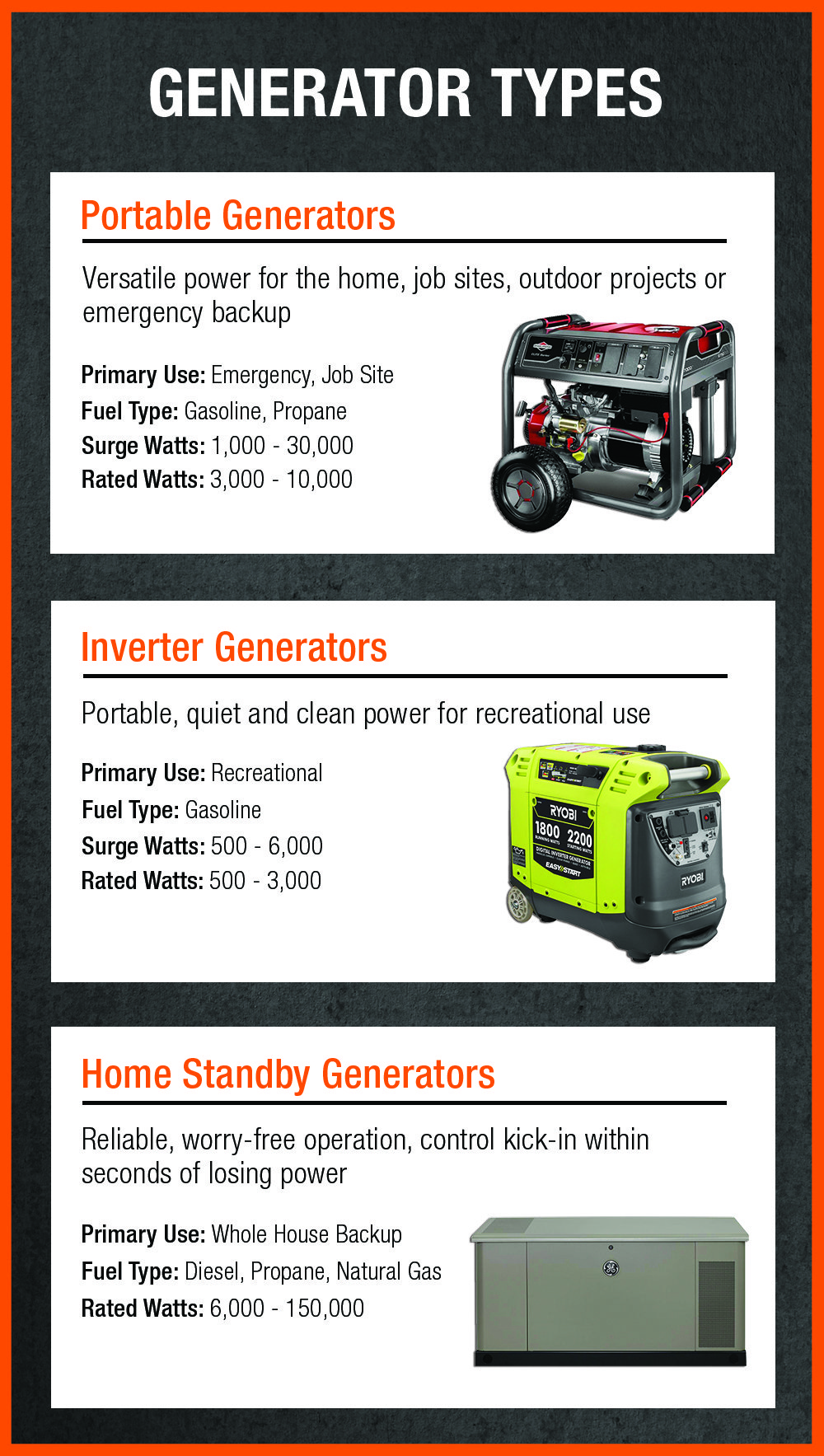
- Home Standby: Permanently installed, automatic, fuel from natural gas/propane. Best for whole-house, hands-off backup.
- Portable: Movable, typically gasoline-powered. Good for essential circuits or specific appliances, requires manual setup.
- Inverter: Quieter, more fuel-efficient portable generators with "clean" power for sensitive electronics.
- Portable Power Stations: Rechargeable batteries, emission-free, safe for indoor use. Best for short-term, quiet backup of smaller loads.
- Connection is Key: A transfer switch or interlock kit is crucial for safely powering home circuits directly.
- Features Matter: Look for automatic CO shutoff, low-oil shutoff, and electric start for convenience and safety.
The Backup Power Imperative: Why a Generator Isn't Just an Option Anymore
Remember the last time the power went out? Maybe it was a summer storm, a winter freeze, or an overloaded grid. For many, these aren't isolated incidents anymore; they're becoming a regular part of life. Without power, your refrigerator becomes a ticking time bomb for groceries, your sump pump can fail, leading to costly floods, and modern conveniences like WiFi and heating are suddenly gone.
Investing in a home generator isn't just about comfort; it's about protecting your property, your food supply, and your family's well-being. It's about taking control when the grid lets you down.
Generator Safety: Your Absolute Top Priority
Before we dive into generator types, let's talk about the most important aspect of owning one: safety. Generators produce carbon monoxide (CO), an odorless, colorless, and deadly gas. Incorrect use can turn a life-saving device into a serious hazard.
Here's the absolute truth about generator safety:
- Outside, Always: Generators must never be operated indoors, in a garage, carport, or even near windows. The exhaust needs to dissipate freely.
- Distance is Key: Position your generator at least 20 feet away from your home and direct the exhaust away from any doors or windows. This ensures fumes don't drift back inside.
- CO Detectors are Non-Negotiable: Ensure your home has working carbon monoxide detectors, preferably interconnected ones, on every level and outside sleeping areas. These are your early warning system.
- Rain Protection: If you're using a portable generator in wet weather, shield it with a generator canopy or cover designed for safe operation in rain. Never operate it directly in the rain without protection.
- Safety Technology: Consumer Reports (CR) strongly recommends portable generators that pass its expanded CO safety technology test. Many modern portable generators feature a built-in CO sensor that automatically shuts off the engine if dangerous CO levels are detected, and some boast engines designed to emit less CO. Look for models certified to ANSI/UL2201 or ANSI/PGMA G300 standards.
Take these precautions seriously. Your family's safety depends on it.
Powering Up Your Decisions: How to Calculate Your Home's Wattage Needs
Choosing the right generator starts with understanding how much power you actually need. Generators are measured in watts (W), indicating their output capacity. A generator too small won't power your essentials, and one too large might be overkill, costing you more upfront and in fuel.
The Simple Way to Calculate Your Wattage
Grab a pen and paper (or open a spreadsheet) and list every appliance and device you want to power during an outage. Then, find their wattage. This information is usually on a label on the appliance itself, in the owner's manual, or easily found online.
Here are some common household items and their typical wattage:
- Refrigerator: 600 watts
- Sump Pump: 750 to 1,500 watts (start-up wattage can be higher, but generators handle surges)
- Portable Heater: 1,500 watts
- Window Air Conditioner: 1,000 watts
- Lights (per bulb): 5 to 80 watts (LEDs are much lower)
- Computer (desktop/laptop): 60 to 300 watts
- Microwave: 600-1,200 watts (running)
- Television: 50-200 watts
- WiFi Router/Modem: 10-20 watts
Add it all up. For instance, if you want to run your refrigerator (600W), a sump pump (1000W), a few lights (100W total), and charge your phone/laptop (100W), your total running wattage would be around 1,800W. A typical home often needs around 5,000 watts to cover a good range of essentials, including a few larger appliances.
Pro Tip: Consider peak "starting" wattage for motor-driven appliances like refrigerators or air conditioners. While these surge for a moment when they kick on, most modern generators are designed to handle these momentary spikes. Focus on the running wattage for your total calculation.
Decoding the Options: Main Generator Types for Home Backup
Now that you know your power needs, let's explore the primary generator types designed for home backup. Each offers distinct advantages and trade-offs in terms of cost, convenience, and capability.
1. Home Standby Generators: The "Set It and Forget It" Solution
Imagine the power going out, and within seconds, your lights flicker back on without you lifting a finger. That's the magic of a home standby generator.
- Description: These are permanently installed units, similar to an outdoor air conditioning unit, connected directly to your home's electrical system via an automatic transfer switch. They run on a continuous fuel source like natural gas or propane.
- How They Work: When an outage is detected, the generator automatically starts, senses grid power loss, and supplies electricity to your home. When grid power returns, it seamlessly switches back and shuts down.
- Installation: This isn't a DIY project. A licensed electrician is required for installation, and costs can often exceed the unit's price due to electrical work, a concrete pad, and gas line connections.
- Fuel Source:
- Natural Gas: Offers an unlimited supply from your utility line, so you'll never run out of fuel during an extended outage.
- Propane: Stored in large tanks (e.g., 250-gallon or 500-gallon). Propane is less risky to store than gasoline and has a long shelf life.
- Features: Beyond automatic start-up, many models offer self-diagnosis, maintenance alerts (via email or text), and remote monitoring.
- Output: Typically range from 5,000 to 20,000 watts, with larger units available. Since installation is a significant cost, it's often recommended to get a slightly larger unit than you think you need, as the difference in installation cost for a bigger generator is minimal.
- Cost: Expect to pay $2,000 to $7,000 for the unit itself, plus several thousand dollars (often $3,000-$10,000+) for professional installation.
- Best For: Homeowners who want whole-house power, maximum convenience, and hands-off operation, especially in areas with frequent or prolonged outages.
2. Portable Generators: Power On the Go (or in a Pinch)
Portable generators are the workhorses of temporary power. They're versatile, relatively affordable, and provide power where and when you need it, provided you follow strict safety guidelines.
- Description: These are movable units, ranging from smaller models for camping and tailgating to larger ones capable of backing up essential home circuits. They require manual starting and fuel management.
- Fuel: Most commonly run on gasoline, which needs to be stabilized if stored for more than a few weeks. Dual-fuel models are increasingly popular, offering the flexibility of gasoline or liquid propane. Propane burns cleaner, which can prevent carburetor clogs and extend engine life.
- Safety Reminders: As discussed, always operate at least 20 feet from your home, directing exhaust away. Shield the unit from rain with a proper canopy.
- Features: Many models offer an electric start (a push-button ignition, though the battery might be an extra ~$50). Some include wheels and handles for easier transport.
- Output: You'll typically find portable generators ranging from 3,000 to 8,500 watts, with some larger units exceeding 10,000 watts.
- Cost: Generally $400 to $3,000, depending on wattage and features.
- Best For: Homeowners who need backup for essential circuits (e.g., refrigerator, sump pump, some lights) and are comfortable with manual operation, refueling, and strict safety protocols. They're also great for job sites, camping, or other remote power needs.
3. Inverter Generators: Quiet Power for Sensitive Electronics
Inverter generators are a more refined version of the portable generator, offering quieter operation and "cleaner" power. They're increasingly popular for home backup, especially for those with sensitive electronics.
- Description: While similar in portability to standard portable generators, inverter models feature advanced technology that allows them to throttle their engine speed up or down to match the power demand. This results in quieter operation and better fuel efficiency.
- Technology: They produce electricity in three phases (AC to DC, then back to AC), which creates a stable, high-quality power output with minimal harmonic distortion. This "clean" sine wave power is ideal for sensitive electronics like laptops, smartphones, and medical equipment that can be damaged by the fluctuating power of conventional generators.
- Efficiency: By adjusting engine speed, inverter generators use less fuel than conventional portable generators, leading to longer run times per tank and fewer emissions.
- Sizes: They vary widely, from lightweight 30-pound units perfect for camping to heavier models (5,000 watts at 220V, over 250 pounds) capable of powering a significant portion of a house.
- Output: You'll typically find them in the range of 900 to 7,600 watts.
- Cost: Generally $400 to $5,000, often costing more than comparable conventional portable models due to their advanced technology.
- Best For: Homeowners who prioritize quiet operation, fuel efficiency, and need to power sensitive electronics. They offer a good balance of portability and refined power.
4. Portable Power Stations: Battery Backup for Emission-Free Living
For those who live in apartments, don't want to deal with gasoline, or simply prefer a silent, emission-free option for short-term backup, portable power stations are a game-changer.
- Description: These are essentially large, high-capacity rechargeable batteries, often referred to as "solar generators" because many can be recharged via solar panels. They store energy and convert it into usable AC power.
- Use Cases: Portable power stations are the only option for indoor use, as they produce no emissions or carbon monoxide. This makes them ideal for apartments, RVs, camping, or simply powering a few essential devices during a short outage.
- Fuel: No gasoline, propane, or diesel needed. They charge via a standard electrical outlet, a car's 12V outlet, or solar panels.
- Advantages: Extremely quiet operation, absolutely no emissions, no fuel storage or maintenance issues (like carburetor clogs), and instant power with the flip of a switch.
- Limitations:
- Power Output: Less powerful than most portable generators, making them less suitable for large appliances or whole-house backup.
- Run Time: Limited by battery capacity; they need to be recharged periodically, which can take several hours depending on the size.
- Cost & Weight: Can be heavier than expected for their power output and generally more expensive per watt than portable fuel generators.
- Output: Typically range from 1,800 to 6,000 watts, with some larger units available.
- Cost: Expect to pay $1,500 to $4,000, with prices varying widely based on battery capacity and features.
- Best For: Apartment dwellers, those sensitive to noise or emissions, or anyone needing short-term, quiet backup for essential electronics, medical devices, or a refrigerator.
Beyond the Big Four: Other Generator Fuel & Mechanism Types
While the four types above cover the vast majority of home backup needs, it's helpful to understand other fuel and mechanism options you might encounter.
By Fuel Source:
- Gasoline Generators: The most common fuel for portable and inverter generators. They're affordable and have straightforward controls, but gasoline has high emission rates and a relatively high long-term fuel cost. Requires fuel stabilization for storage.
- Diesel Generators: Mostly found in larger standby units. Diesel is more fuel-efficient than gasoline, leading to lower fuel costs over time, and it performs well in freezing temperatures (with winterized diesel). Diesel engines are known for their durability. However, they produce harmful emissions.
- Natural Gas Generators: Predominantly used for home standby systems. These offer significantly lower emissions than diesel and an unlimited fuel supply if connected to your home's gas line. They are durable and long-lasting with proper maintenance but have high initial installation costs and can be vulnerable to extreme cold impacting gas pressure.
- Propane Generators: A popular choice for home standby and dual-fuel portable units. Propane is easy to find and store in tanks, and it performs effectively in cold temperatures. While cleaner-burning than gasoline, propane generally costs more than natural gas and burns faster than diesel.
- Biodiesel Generators: An eco-friendly alternative for diesel units, using a blend of diesel fuel, vegetable oil, and animal fat. This reduces reliance on nonrenewable fuels and lowers emissions. However, sourcing biodiesel during extended outages can be unreliable if fueling centers are distant.
- Hydrogen Generators: A newer, rare technology for home use, fueled by hydrogen gas through internal fuel cells. They offer high power output, sturdy construction, and are incredibly quiet. The main drawbacks are their high cost and limited availability.
By Mechanism:
- Induction Generators: These generators create electromagnetic fields to generate energy. They require a significant amount of mechanical energy to start and primarily find use in large-scale applications like wind turbines and mini hydro plants. Due to their unstable wattage output, they are generally not suitable for home backup.
Smart Features That Make a Difference
Beyond the core type and wattage, specific features can significantly impact your generator's safety, convenience, and usability.
- Automatic CO Shutoff: This is a crucial safety feature for portable and inverter generators. If carbon monoxide levels in the operating area reach dangerous thresholds, the engine automatically shuts down. Look for models with ANSI/UL2201 or ANSI/PGMA G300 certifications for proven performance.
- Low-CO Engine: Some generator engines are specifically designed to produce lower levels of carbon monoxide, offering an extra layer of safety. Brands like Ryobi and Echo have focused on this technology.
- Automatic Start: Common in stationary (home standby) models, this feature means the generator detects a power outage and starts itself, providing seamless backup without any manual intervention.
- Electric Start: For portable and inverter generators, an electric start offers push-button convenience, eliminating the need for pull-cord starting. Be aware that the battery may be an additional cost (around $50).
- Alternative Fuel Capacity (Dual-Fuel/Tri-Fuel): The ability to run on multiple fuel types (e.g., gasoline and propane, or even natural gas with a conversion kit) provides flexibility, especially if one fuel source becomes scarce.
- Fuel Gauge: A simple but incredibly useful feature for portable generators, allowing you to easily monitor fuel levels and plan for refueling.
- Low-Oil Shutoff: This protective mechanism automatically shuts down the generator engine if oil levels fall below a safe minimum, preventing potentially costly engine damage.
- Multiple Outlets: Portable models should offer four or more outlets to help spread the electrical load and connect various appliances. Look for a mix of standard 120V outlets and a larger 240V outlet if you need to power larger appliances or use a transfer switch.
- Removable Console: A very convenient feature that allows you to plug your appliances into a console that can be positioned closer to your home, avoiding the need for excessively long or risky extension cords run directly from the generator.
Connecting Your Generator Safely: Transfer Switches and Interlock Kits
Once you've chosen your generator, the next critical step is safely connecting it to your home's electrical system. This isn't just about convenience; it's about protecting your home, your appliances, and utility workers. Never "backfeed" power into your home by plugging a generator directly into a wall outlet – this is extremely dangerous and illegal.
Transfer Switch: The Gold Standard for Integration
A transfer switch is a dedicated electrical panel that safely connects your generator to your home's circuit panel using a single, heavy-duty cable.
- How it Works: It isolates your home's electrical system from the utility grid before allowing generator power to flow in. This prevents "backfeeding," where electricity from your generator could travel back through the power lines, endangering utility workers trying to restore power.
- Operation: For whole-house (standby) generators, transfer switches are automatic, sensing an outage and switching power sources seamlessly. For portable models, they are typically manual, requiring you to flip a switch to select between utility and generator power.
- Benefits: Allows you to power hardwired essentials like well pumps, furnaces, and specific light circuits directly from your home's electrical panel, eliminating the need for multiple extension cords.
- Installation: A licensed electrician is required to install a transfer switch, which typically costs $500 to $900 for the labor and the unit itself. It's helpful to use a digital circuit breaker finder to identify and label your essential circuits beforehand.
- Requirements: Most transfer switches designed for home backup require a 220-volt input from the generator and a generator with at least 5,000 watts of output.
- Learn More: To ensure your setup is both safe and effective, understanding how to properly connect a generator to your home is crucial for your peace of mind during an outage.
Interlock Kit: A Cost-Effective Alternative
An interlock kit provides a more affordable way to achieve safe generator connection to your entire circuit breaker panel.
- How it Works: This mechanical device ensures that your main utility breaker is always in the "off" position when your generator breaker is "on," and vice versa. It physically prevents both from being on simultaneously, thereby eliminating backfeeding.
- Benefits: Allows your generator to power any circuit in your home (up to its wattage capacity), providing more flexibility than a fixed transfer switch, all while maintaining safety. It also protects your electronics and utility workers by preventing the generator from running when grid service is restored.
- Cost: Generally $100 to $200 less than a dedicated transfer switch, making it an attractive option for budget-conscious homeowners.
- Installation: Also requires a licensed electrician to install.
What to Look For: Testing & Trusted Brands
When making such an important investment, relying on reputable sources and brands is key. Organizations like Consumer Reports (CR) rigorously test generators to help consumers make informed decisions.
CR Testing Methodology Highlights:
CR engineers push generators to their limits, ensuring they can handle their promised loads and sudden voltage spikes, much like your refrigerator kicking on. They also assess critical factors like:
- Ease of Movement and Use: How easy is it to start, move, and operate?
- Fuel Efficiency: How long does it run on a tank of fuel?
- Run Time: How many hours of operation can you expect?
- Safety: Using calibrated CO sensors in custom chambers, they measure CO output and test automatic CO shutoff features.
Trusted Brands Tested by Consumer Reports:
You'll often find these brands performing well in tests and reviews:
- Briggs & Stratton
- Cat (Caterpillar)
- Champion
- DeWalt
- Echo
- Generac
- Honda
- Ryobi
While specific models vary in performance, these manufacturers generally have a strong reputation for reliability and customer support.
Your Next Steps: Choosing the Right Generator for Your Home
You're now equipped with a comprehensive understanding of generator types and what to look for. Your decision will ultimately come down to a few key factors:
- Your Power Needs: What specific appliances must run during an outage? Recalculate your wattage if needed.
- Budget: What are you willing to spend on the unit and its installation?
- Convenience vs. Cost: Do you want a completely hands-off automatic system, or are you comfortable with manual setup and refueling to save money?
- Fuel Availability & Storage: Do you have natural gas lines, or are you comfortable storing gasoline or propane?
- Noise & Emissions: Is quiet operation or emission-free power a top priority?
- Safety Features: Prioritize automatic CO shutoff and low-CO engines, especially for portable units.
Whether you opt for the seamless integration of a home standby system, the rugged versatility of a portable generator, the quiet efficiency of an inverter, or the silent power of a portable power station, having a plan for backup power is an intelligent move. Don't wait for the next outage to start thinking about it. Make your choice, ensure safe installation, and enjoy the peace of mind that comes with knowing your home is prepared.